Transitions: September News from the Studio

 
One good thing from 2020: A successful pumpkin patch.

One good thing from 2020: A successful pumpkin patch.


I knew that 2020 was going to be a year of changes, but I could never have predicted the tumultuous twists and turns the year has taken. We knew that we’d be moving our first born, Maddie, into college this fall; but we did not foresee that exactly one month and one day after we moved her into the dorm, we’d be moving her back out. It was tough watching her miss the end of her senior year, have a very modified high school graduation and then decide to skip the planned party due to Covid complications. But I think this past month has been the worst (maybe because it involved so much physical labor.) She spent a good deal of the summer (and graduation money) planning the perfect dorm room and the move in was very smooth. We all had high hopes and held our breath. Maddie came back home, the first time, after one week with a suitemate in tow, because her own roommate went to get a test. The entire suite had to leave the dorm until the results came back. The test was negative, they went back. A week later she thought maybe she wasn’t feeling well and came home, the next morning she felt fine and headed back to the dorm. The university announced all classes were going online and her roomate left for good. Three days later a suitemate, a cheerleader, had a routine test come back positive. The remaining nine girls in the suite got tests and evacuated to quarantine housing. The tests were positive. Facing ten more days in the isolation dorm, Maddie and a friend chose to spend the rest of their quarantine at the girl’s family home on Emerald Isle. In the meantime, the university closed all housing. Maddie stayed safely at the beach taking her online classes and texting up a storm, while I scrambled to figure out where she could live. Because now, to all four of us, her coming home felt like a let down we couldn’t really bear. Her grandparents came to the rescue: offering up their rarely-used Raleigh apartment as a residence for she and a roommate. Now she and a good friend from high school, herself an evacuee from UNC Chapel Hill, are comfortably ensconced (and seriously upgraded) at an apartment in North Hills. She has a car, privacy, and lots of cushee amenities. I dropped by yesterday and she proudly showed me the neatly arranged groceries in the fridge — everything she needed to make a big batch of low mein. It was a good scene — two years earlier than I ever expected such a scene, but you’ve got to take the good when you can get it.

Bayleaf Market in progress . . .

Bayleaf Market in progress . . .

Needless to say, these events and the corresponding roller coaster of emotions have dominated my life lately. But, I did do some other things. Also in August, my friend Courtney Pernell signed the lease on a space that she will turn into a studio and marketplace for art and handmade goods. Very exciting news and a lot of work for Courtney as she converts what was basically a glorified farmer’s vegetable stand into a year-round studio and display space. I’ve helped out some — the floor boards in the picture at left were laid by yours truly. When it’s done it will be a lovely space; I’m looking forward to having creative work for sale in the market, and possibly teaching some art-themed classes and workshops!

I’ve also listed some new items in my Etsy shop, The Muse and the Magpie, and will be posting more throughout September and October. I’ve really enjoyed creating small scale collage on handmade gift tags and will definitely be creating some tags and cards for the upcoming holidays. I’ve listed a couple favorite pieces that have been a little hard to let go . . . I’m making new work — there’re projects underway and lots of plans. I’m crossing my fingers for a more routine schedule and a lot less drama for the rest of the fall.

I also have blog posts in the works and plan on publishing three between now and the end of November: a tutorial for some cute and easily crafted organizers; tips on creating gallery walls with an update on the mini gallery I created in my half bath (in lieu of putting up wallpaper); and in November — some simple tips on how to create art from special objects and memorabilia. In the meantime, here’s a post from last year to help get you in the mood for the changing seasons.

Summary Block
This block has no content yet. Items you add to the page connected to this block will display here.

The Highly Adaptable Heart

winter decor1c.png

Valentines Day — do you love it, hate it, or are you indifferent? At this stage of my life, I fall mostly into the latter category. (Although I will never object to flowers or chocolate.) But I love the heart — that ubiquitous symbol of love which you just can’t escape in February. We automatically associate the heart with romantic love, but its appealing shape often shows up in places that have nothing to do with Valentines Day. The heart has come to represent “love” in the most general sense and lends itself to all kinds of applications — everything from being just a pretty decorative motif to a very expressive emoji.

So how did this particular shape come to be the universally accepted metaphor for human emotion? Explanations vary, but one consistent rumor places a fennel-like plant, the Silphium, in the ancient mediterranean world where it was recognized as an effective contraceptive. (I guess when steeped and drunk as a tea?) The Silphium seed pod formed a perfect heart shape and was a rare and valuable trade commodity. The North African city central to the Silphium trade featured a heart-shaped emblem on its currency. The plant was extinct by the first century AD, but it’s not hard to see the connection between the heart-shaped seeds used for contraception and the association of the shape with romantic love. Although It wasn’t until the Renaissance that the heart became a widely used symbol for the emotions of love and affection, and in religious connotations, the sacred love of Christ.

Hearts decorate the mantel in my kitchen in January and February.

Hearts decorate the mantel in my kitchen in January and February.

I keep an art journal for experimenting with mixed-media techniques. A page can be completed fairly quickly and I think of it simply as note taking for my own use. I frequently use the heart shape when I’m trying to get a sense of the effects a technique offers — you can do just about anything with it and it’s still recognizable as a heart. (Flowers work well that way too, but that’s another topic.) The picture below shows some pages from my current journal. The photo on the bottom left shows one page that I divided into four parts to try different methods of layering paper and paint.

 
BP8_Art Journal.png
 

We often associate the heart with the home — think of expressions like, “Home is where the Heart is” and the kitchen as being “the heart of the home.” Hearts offer a warm and whimsical decorative touch and are adaptable for styles from traditional to modern. Below are instructions for two easy DIY projects that you can use to bring hearts into your own home. While I’m a huge fan of the color pink, most of the hearts that decorate my house are in a neutral palette as shown in these projects. But hearts work in any color, so feel free to follow your own muse.

 
BP8_Heart Collage.png


Instructions

  1. Gather your supplies and prepare your canvas with either paint or fabric (see note above).

  2. Make a heart template on paper. Size it to fit comfortably on the canvas.

  3. Make your collage: take a used dryer sheet (you may need to iron the sheet to smooth it out first) and apply paper scraps in a random pattern to cover the sheet. You can brush glue on to each piece of paper or coat the sheet with the glue and then press the paper onto the surface. Either way, make sure the paper is thoroughly glued down to the sheet (place the dryer sheet on wax paper to prevent getting glue on your table surface).

  4. Brush a thin coat of glue over the surface of your collage and allow it to dry.

  5. Once the collage has dried, flip the dryer sheet over and trace your heart template on the back. Cut out the heart shape.

  6. To attach the collage to the canvas, brush glue to cover the back side of your heart and carefully place it in position. Lightly press on the heart and use a damp paper towel or sponge to wipe off excess glue that seeps from the sides.

  7. Place a piece of wax paper over the collaged canvas and then a book on top of the wax paper. Allow the collage to dry over night. Add a saw-tooth picture hanger on the top back side of the canvas if you want to hang it, or simply prop the canvas up on a shelf.


BP8hb2.png
 

Instructions

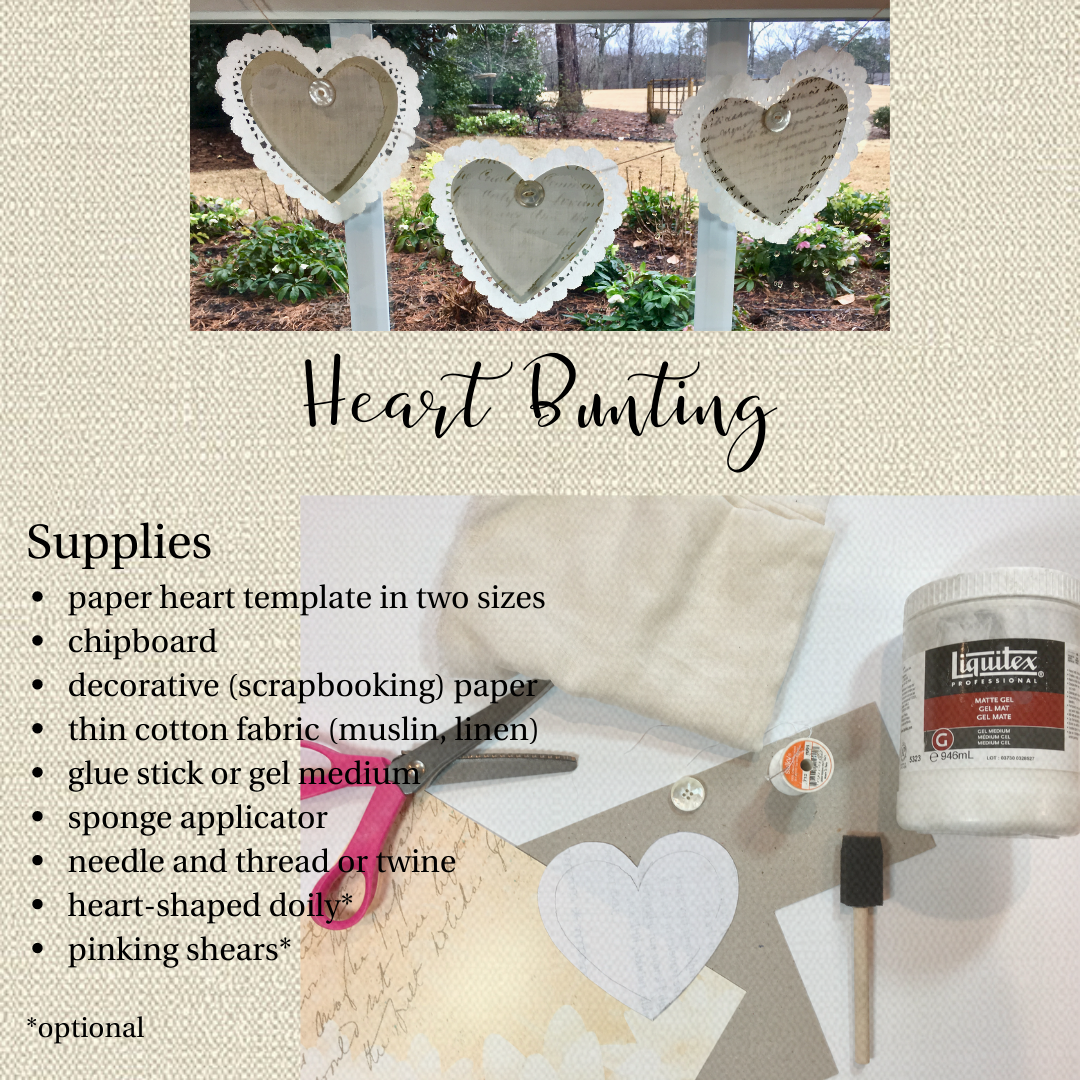
  1. Gather your supplies. If you can find heart-shaped doilies, they’re cute — but not essential. You can use heavy string or thin twine. Twine hangs better but you will need to make sure the eye of your needle is large enough to thread the twine through.

  2. Create heart templates in two sizes, one slightly smaller than the other.

  3. Cut a heart shape from your chipboard using the larger heart template. Using the same template, cut a heart from your decorative paper.

  4. Brush a thin coat of glue on the chipboard heart and lightly press the decorative paper heart on top, lining up the edges. Gently press the two pieces together and wipe excess glue from the sides with a damp paper towel or sponge.

  5. Using the smaller template, cut a heart shape from your fabric. Using pinking shears adds a decorative edge to the fabric, but is optional.

  6. If you are using doilies, glue the chipboard heart to the doily and allow to dry.

  7. Repeat this process for as many hearts as you would like to have in your bunting.

  8. Lay the chipboard hearts in a line and match each with a fabric heart. You may want to use a dab of glue to secure the fabric heart to the paper heart.

  9. Place a button at the top of each heart, in the crevice. Push the needle from the back of your first heart through one hole of the button. Draw the thread and needle through the other hole to the backside of the heart. Repeat this process using the same long piece of thread or twine for each heart. (See tip below. ) Leave enough of a thread or twine “tail” at the start and end of your bunting to use for hanging.

 
BP8hb1.png

Happy Valentines Day!


Seasonal Still Lives: Simple Tweaks Mark the Changes of the Year

Small wall shelf in guest bathroom, mid-September through end of November

Small wall shelf in guest bathroom, mid-September through end of November

 I change up the items decorating many of the shelves and tabletops in my home every couple of months, on average. Each changing season offers a different theme, a new color palette, an opportunity to shuffle things around and create an artful arrangement. It is time consuming — not only do new things go up but things come down and have to be put away. But I enjoy creating vignettes; it’s another form of visual composition, just in 3-D not on a canvas. I also love to treasure hunt, I never pass an antiques shop or  flea market and not wish I could stop. Mixing up my decorative vignettes seasonally gives me a way to keep the treasures in rotation (and an excuse to keep hunting them down.)

I used to think I must be some kind of crazy to do this, but then Pinterest came along and I realized I’m definitely not alone.

Fall, in particular, offers an abundance of decorating options.  I love Halloween — not the gory, horror-type but more the folksy, traditional, makes you think of a Grandma Moses painting-type. I’ve been collecting Halloween decorations since we were first married. But I’m a little late to be posting about Halloween, today I transitioned the decor to a more general fall theme for November.  We went from witches to acorns and squirrels.

This may sound a little over the top, after all Christmas is right around the corner. But I’ve got some tricks for a quick change up and it didn’t take too long; it still felt like a pleasure not a chore. For Christmas I will start with a blank slate, but to make the distinction between Halloween and Thanksgiving I just did a little adding and subtracting and shuffled some things around. There are other times during the year when I do this, but adding a little Easter into Spring, or 4th of July into Summer takes even less time. We just happen to have a lot of Halloween stuff and my girls, even though they’re teenagers, really love to see it up every year.

Here is my number one tip for making frequent vignette changes easy:

  • Keep the same arrangement, just switch the objects in it.

Blogpost3C5.jpg

This vignette on the hall table includes two decoupaged plates and a decoupaged faux pumpkin. The plates switch from a rat and jack-o-lantern to an autumn scene and turkey. The pumpkin stays.

Blogpost3C3b.jpg
Blogpost3C4 (1).jpg
blogpost3c1 (1).jpg

I salvaged the cabinet doors when we remodeled our kitchen and have painted several with seasonal themes to place on the shelf above the range. I wasn’t so happy with the landscape on the Thanksgiving one, but the lettering came out as I’d imagined. I’m going to be making a folding screen for our living room from the old pantry doors using a similar style of painting a landscape within the panels. We’ll see how that goes . . .

A few more tips:

  • Just switching from votives to candlesticks or pillars can change the mood of an arrangement.

  • Have core elements that always stay the same and just arrange smaller items around them — for example, the framed picture on our family room mantel.

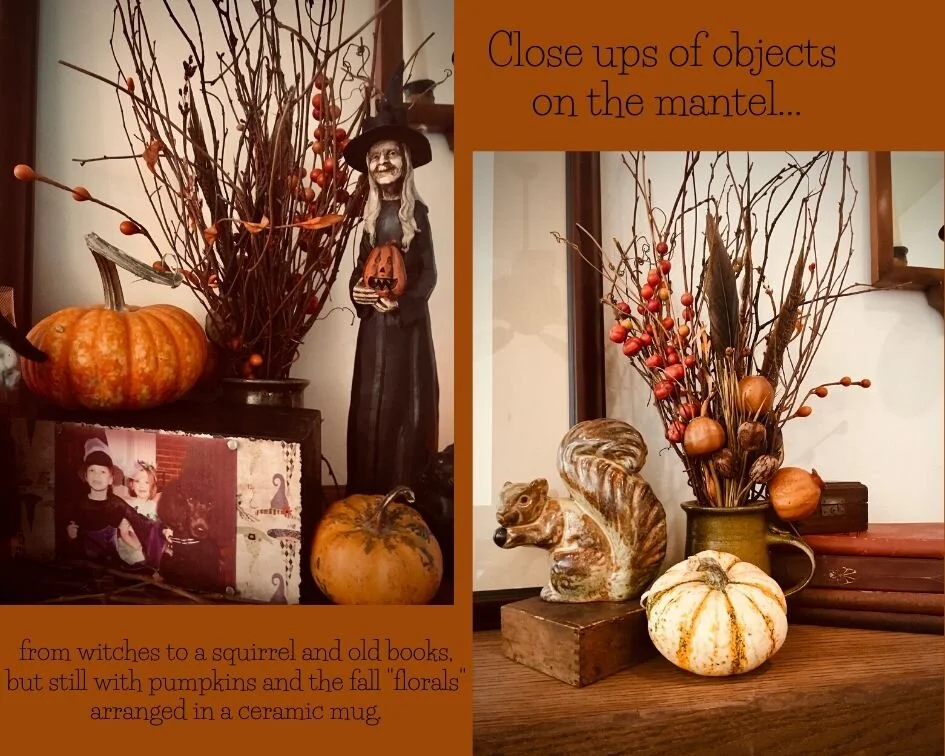
  • Objects from nature are one of the simplest ways to suggest a new season and the easiest to switch out. The bare branches in the mug on the mantel could have been asters in September; you could get from September through February with a bowl filled with apples, then mini pumpkins and then small pinecones.

Dining room table centerpiece, mid-September through end of November

Dining room table centerpiece, mid-September through end of November

I’ll be sharing photos of my vignettes as they change over the course of the year. I hope you’ll enjoy the pictures and who knows, there may be an idea or two you want to borrow to celebrate the changing seasons in your own home.